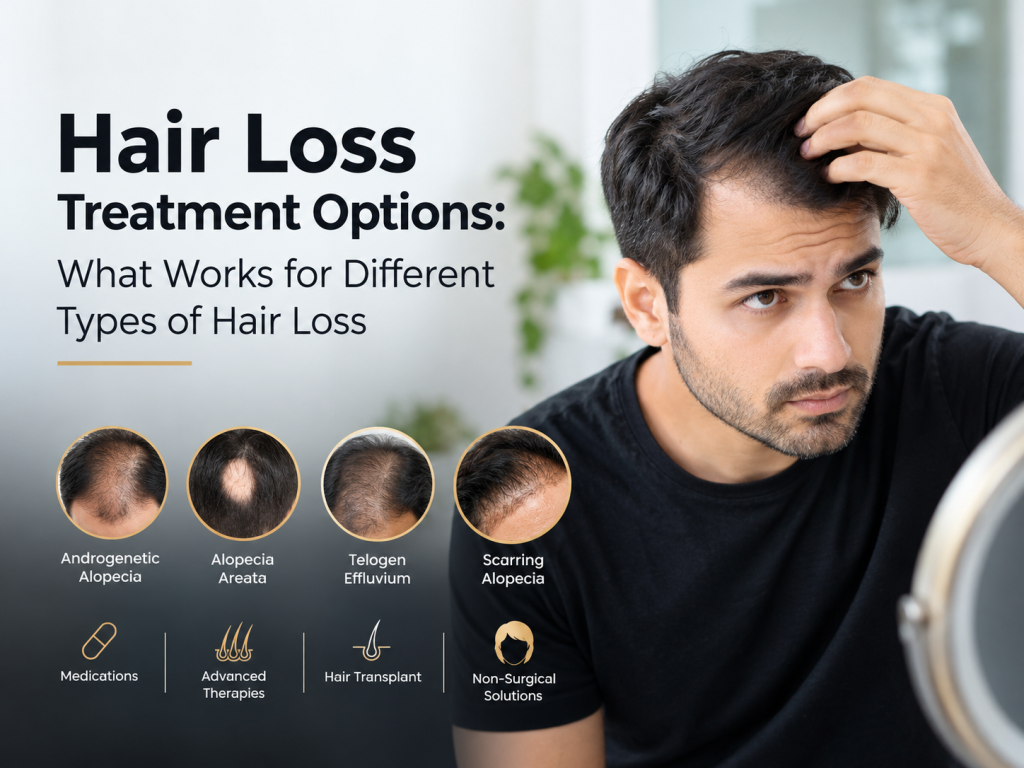
Have you been trying to figure out why your hair is falling and, more importantly, what you can actually do about it? The answer to this may depend on the type of hair loss you have.
You could be dealing with gradual pattern thinning, sudden shedding after stress or illness, bald patches, or hair loss caused by repeated pulling. Each type of hair loss has a different cause, so the treatment that helps one may not work for another.
Minoxidil, for example, can help some people with pattern hair loss, but it does not address the immune response behind alopecia areata or the trigger behind stress-related shedding.
That is why identifying your type of hair loss comes first. Once you know what is causing the problem, you can choose a treatment that actually targets it. Here are the common types of hair loss and the treatment options that may help.
Pattern Hair Loss
Have you started noticing more scalp around your parting, a receding hairline, or less hair around your crown? That slow change can be frustrating because it often happens so gradually that you may not realise how much density you have lost until it becomes visible. Pattern hair loss, also called androgenetic alopecia, is one of the most common forms of hair loss. It can affect both men and women, although the thinning pattern often differs between genders.
What Causes Pattern Hair Loss?
There is usually more than one factor behind pattern hair loss, including:
- Genetics: Your genes can determine how sensitive your hair follicles are to androgens. If pattern hair loss runs in your family, you may be more likely to develop it.
- DHT sensitivity: In genetically sensitive follicles, DHT can gradually shorten the growth phase and cause the follicles to become smaller. The hairs produced by these follicles then become finer and shorter.
- Ageing: Hair growth naturally changes with age, which can make existing genetic hair thinning more noticeable over time.
This is why simply changing your shampoo or applying more hair oil may not solve the problem. You need a solution that can address the underlying change that is taking place inside the hair follicles.
Hair Loss Treatments for Pattern Hair Loss
There are several treatment options for pattern hair loss in men and women. However, the right one always depends on your sex, age, health, stage of hair loss, and other individual factors.
- Topical minoxidil: Applied to the scalp, minoxidil can help stimulate hair growth and slow further thinning. It needs regular use, and results usually take several months to become noticeable.
- Oral minoxidil: Doctors may prescribe low-dose oral minoxidil for selected patients. Since it can affect blood pressure and cause other systemic side effects, it should be taken only under medical supervision.
- Finasteride: This prescription medicine reduces DHT production and can help slow follicle miniaturisation. Finasteride is commonly used to treat male pattern hair loss around the globe.
- Dutasteride: Like finasteride, dutasteride reduces DHT activity. A doctor may consider it for selected patients when a stronger reduction in androgen activity is appropriate.
- Spironolactone: This anti-androgen medicine may help some women with pattern hair loss. Whether it is suitable depends on individual health, hormonal factors and pregnancy considerations.
The approach to hair loss treatment for men can therefore differ from hair loss treatment for women. Moreover, a treatment that suits and was really effective for one person may not be appropriate for another.
If pattern hair loss has already progressed significantly, other options such as PRP or hair transplantation may also be considered. Their suitability, however, depends on the condition of the existing follicles and the availability of healthy donor hair.
Diffuse Hair Loss or Telogen Effluvium
Have you suddenly started finding much more hair on your pillow, clothes, comb, or in the shower? Diffuse hair loss can be unsettling because the shedding happens across the scalp rather than in one clearly defined area. Telogen effluvium is, in fact, one common cause of this type of widespread shedding. It can develop after a major physical or emotional strain and may become noticeable weeks or months after the trigger.
What Causes Diffuse Hair Loss?
There can be several triggers behind telogen effluvium, including:
- Illness or high fever: A significant illness can temporarily disrupt the normal hair-growth cycle and push more hairs into the shedding phase.
- Severe stress: Prolonged emotional or physical stress can affect the hair cycle and lead to increased shedding.
- Pregnancy and hormonal changes: Changes in hormone levels around pregnancy and after childbirth can temporarily alter the hair-growth cycle.
- Rapid weight loss or nutritional deficiencies: Losing weight quickly or not getting enough essential nutrients can place additional stress on the body and affect normal hair growth.
- Surgery or other physical stress: Major surgery or another significant physical strain can sometimes trigger excessive shedding.
The good news is that telogen effluvium is often temporary. This however does not mean that hair loss treatment is not needed. You should still find the root cause behind the shedding.
Hair Loss Treatments for Diffuse Hair Loss
The right type of hair loss treatment for telogen effluvium depends on what caused the shedding in the first place. Treating that trigger is usually the most important step.
- Address the underlying cause: If a thyroid problem, nutritional deficiency, illness, or another health issue is responsible, treating that problem can help the hair-growth cycle return to normal.
- Improve your nutrition: Make sure your diet provides enough protein, iron, and other essential nutrients. Supplements should only be taken when a deficiency has been confirmed or recommended by a doctor.
- Give your body time to recover: Hair does not always return to its normal growth cycle immediately after the trigger is addressed. Shedding can take time to settle, followed by gradual regrowth.
- Minoxidil: In selected cases, a doctor may recommend minoxidil to support hair density while the underlying issue is being addressed. It does not, however, replace treatment for the original trigger.
This is why hair regrowth treatment for telogen effluvium is often very different from other types of hair loss, like pattern hair loss in men and women. Identifying and managing the trigger for diffuse hair loss can gradually help hair to move back into its normal growth cycle.
Patchy Hair Loss or Alopecia Areata
Have you noticed a small, smooth bald patch appearing on your scalp without warning? You may even find that the surrounding hair looks completely normal. That pattern can be a sign of alopecia areata, an autoimmune form of hair loss that can affect people of any age.
Unlike gradual thinning, alopecia areata often appears suddenly. It can affect one small area or several parts of the scalp, and in some cases, it can also affect eyebrows, eyelashes, or other body hair.
What Causes Alopecia Areata?
Alopecia areata happens when the immune system mistakenly targets the hair follicles. Several factors can actually cause it to happen, including:
- Autoimmune activity: The immune system attacks healthy hair follicles and disrupts their normal growth cycle.
- Genetic factors: Having a family history of alopecia areata or other autoimmune conditions may increase the likelihood of developing it.
- Other triggers: Illness, significant stress or certain environmental factors may play a role in triggering or worsening the condition in some people.
The important thing to remember here is that alopecia areata is not simply a problem of weak hair or poor hair care. Hence, simply applying oils, changing shampoos, or taking random hair supplements will not address the immune response affecting the follicles.
Hair Loss Treatments for Alopecia Areata
Treatment for this type of hair loss in women and men depends on how much hair has been affected. It also depends on how quickly the patches are developing, and whether the condition is recurring. A hair consultant in Delhi may recommend some of the mentioned treatments based on the pattern of your hair loss:
- Corticosteroid injections: For a few localised patches, a dermatologist may inject corticosteroids directly into the affected areas to calm the immune response and encourage regrowth.
- Topical corticosteroids: Prescription creams or solutions may be used on affected areas, particularly when injections are not suitable.
- Other prescription treatments: More extensive or persistent alopecia areata may require medicines that target the immune response. A dermatologist can determine whether these are appropriate.
Some people experience spontaneous hair regrowth, while others may need additional hair treatment to encourage it. The right hair regrowth treatment therefore depends on confirming that the bald patches are actually caused by alopecia areata.
Traction Alopecia
Have you noticed thinning around your hairline after wearing tight ponytails, braids, or extensions regularly? That repeated pulling can, in fact, place constant tension on the hair follicles and gradually lead to traction alopecia. This type of hair loss often starts as thinning around areas that experience the most tension, such as the front and sides of the scalp.
What Causes Traction Alopecia?
There is usually a clear connection between the hairstyle and the hair loss when it comes to traction alopecia. It is often triggered by:
- Tight hairstyles: Ponytails, braids, buns, and other styles that pull firmly on the hair can repeatedly strain the follicles.
- Hair extensions: Extensions can add extra weight and tension to the hair, especially when they are attached tightly.
- Repeated pulling: Wearing the same tension-heavy hairstyle regularly can keep stressing the follicles and worsen the thinning over time.
The good news is that early traction alopecia may improve once the tension stops. Continued pulling, however, can eventually damage the follicles permanently.
Hair Loss Treatments for Traction Alopecia
Its usually simple to treat traction alopecia. All you need to do is remove the source of tension before the damage progresses by:
- Choosing looser hairstyles: Avoid styles that pull tightly on the hairline or scalp, and change your hairstyle regularly to reduce repeated tension.
- Giving your hair a break from extensions: Removing extensions can reduce the additional weight and pulling placed on the follicles.
- Handling your hair gently: Avoid unnecessary pulling or harsh handling, particularly around already-thinning areas.
- Seeking professional treatment if thinning continues: A dermatologist can check whether the follicles are still capable of regrowth and recommend a suitable hair regrowth treatment when needed.
Once the follicles have been permanently damaged, simply changing your hairstyle may not restore the lost hair. That is why recognising traction alopecia early matters, and consulting a hair specialist in Delhi can help with that!
The Right Treatment Starts With the Right Diagnosis
Hair loss can happen for many reasons, and the treatment that works for one type may not work for another. That’s exactly why it is really crucial to identify the cause of your hair loss.
You do not have to keep guessing or trying different remedies without knowing what your hair actually needs. A proper assessment by a hair specialist in Delhi can actually help you understand the type of hair loss you have and the treatment options available for it.
Experts from Radiance Hair Studio are here to help you understand your hair loss and explore suitable hair restoration and replacement options. Our team can guide you towards an approach that fits your type of hair loss, your concerns, and your goals.
Contact our hair specialist in Delhi or visit our Radiance hair studio today.
FAQs
Q. What is the best treatment for hair loss?
Ans: The treatment for any hair loss depends of the type of loss, the person, and many additional factors.Pattern hair loss may be treated with minoxidil or prescription medicines such as finasteride or spironolactone. Telogen effluvium usually requires addressing the underlying trigger, while alopecia areata may need corticosteroid treatment.
Q. How do I know which hair loss treatment is right for me?
Ans:A proper assessment by a hair specialist in Delhi can help identify the type and cause of your hair loss. Your treatment can then be selected based on your hair-loss pattern, health, and individual needs.
Q. Can hair loss be reversed with treatment?
Ans:Some types of hair loss can improve when the underlying cause is addressed in the early stages of loss. However, treatment results depend on the cause, extent of follicle damage, and how long the hair loss has been present.
Q. Can hair loss grow back naturally?
Ans: Yes, some types of hair loss, such as temporary shedding caused by stress or illness, may improve once the trigger is addressed. Regrowth depends on the cause and whether the hair follicles are still healthy.
Q. When should I consult a hair specialist for hair loss?
Ans: Consult a dermatologist if you experience sudden or persistent hair loss, visible bald patches, scalp discomfort, or rapidly increasing thinning. Early assessment can help identify the cause and prevent further damage.