Choosing a hair wig for women in Delhi often begins with excitement, but quickly turns into uncertainty. You compare styles, colours, and hair quality, yet something still feels unclear. Why does one wig look effortless while another feels slightly unnatural? The answer often lies in hair density.
This article helps you understand how density shapes realism, comfort, and confidence. By the end, you will not only recognise what density means in practical terms, but also how to choose what truly works for you.
What Hair Density Actually Means When You Wear A Wig?
When women begin exploring a hair wig for women, most conversations revolve around colour, texture, or style. These feel like the most visible decisions. Yet the moment the wig is worn, something else becomes immediately noticeable. How full does it feel? How naturally does it sit? Does it blend or does it stand apart?
This is where hair density quietly enters the conversation.
Hair density simply refers to the amount of hair that has been used to construct the wig. In real terms, it decides how light or full the wig appears once it becomes part of your daily life. Remember:
- It is not about strand thickness.
- It is not about hair quality.
- It is about overall visual balance.
Then what is it really about? It is about proportion. It is about how the wig aligns with your:
- Natural hair pattern,
- Facial features
- Personal styling habits.
The right density allows the wig to sit comfortably within your overall appearance instead of overpowering it.
When density is chosen correctly, the wig feels like an extension of you. When it is not, even the best human hair wigs for women can look slightly disconnected. That difference is subtle, yet strong enough to influence how natural the final result feels.
Why Density Quietly Shapes How Natural a Wig Feels?
Have you ever seen a wig that looked perfect in photographs but slightly different in real life? In most cases, the reason is not hair quality. It is density.
Hair density influences how naturally a wig blends once you begin wearing it in everyday situations. Density may even sound like a technical detail when choosing a hair wig for women. However, it is often the factor that determines whether the result feels seamless or visually separate.
This happens because our eyes are instinctively trained to recognise natural volume patterns.
- When a wig carries more fullness than your natural hair would, the contrast becomes noticeable.
- When a wig carries too little fullness, the result can feel incomplete.
In both situations, the issue is not the hair itself. It is the balance.
But remember, the real objective is not to add maximum volume to a human hair wig for women. It is instead to create a visual harmony.
- When density reflects your natural growth pattern, the wig settles into your appearance with ease.
- When it does not, subtle inconsistencies begin to draw attention.
This is why density is often considered a structural starting point. It quietly shapes how the wig sits, how it moves, and how convincingly it becomes part of your everyday presence.
Signs You May Have Not Chosen The Right Density Of Hair Wig For Women
Have you ever worn a wig that looked perfect in the mirror but somehow felt different once you stepped outside? Many women experience this quiet discomfort in the beginning. You may not immediately know what feels wrong. You only sense that the wig does not fully blend into your natural appearance.
In most cases, the reason is not hair quality but the density of the human hair wig for women. When density is not aligned with your natural proportions, subtle visual imbalances begin to appear over time.
You may start noticing signs such as:
- The wig appears heavier than your natural hair near the sides or neckline
- The overall volume looks exaggerated in daylight or photographs
- The front hairline feels thick instead of soft and gradual
- Hair movement feels dense or slightly rigid rather than fluid
- The wig draws attention even when the styling itself is correct
These experiences often indicate a mismatch in density rather than a flaw in the human hair wig for women. But why does this happen? Understanding how density percentages translate into real-life appearance can help clarify why this happens.
Understanding Wig Density Percentages in Real-Life Terms
Once you realise that density affects how natural a wig looks, the next question becomes inevitable. What do these percentages actually mean in real life?
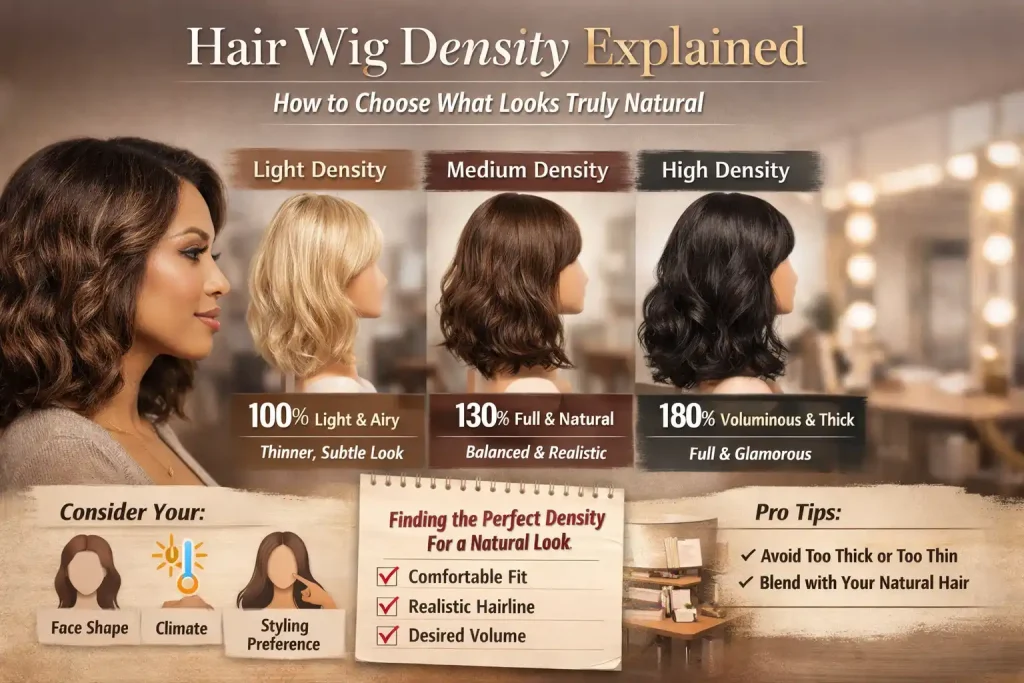
Hair density is usually described in numbers. But what truly matters is how that number translates into visual balance, comfort, and daily confidence. Different density levels create completely different impressions once the wig is worn. For instance:
Light Density (100% – 110%)
A hair wig for women created with this level of density creates a very soft and understated appearance. It works best for women who naturally have fine hair or who want minimal, subtle coverage.
Human wigs with these densities often offer a more natural look. However, “volume” is often considered as one of their limitations. In bright lighting or styled settings, this density may feel too light for women expecting a fuller transformation.
Natural Everyday Density (120% – 130%)
A hair wig for women with this range of density is widely considered the most practical for daily wear. It provides enough fullness to feel confident while still looking believable in close interactions.
Most first-time wig users find this density easiest to adapt to because:
- It mirrors common natural hair thickness
- It feels balanced across face proportions
- It allows flexible everyday styling
Fuller Density (140% – 150%)
A hair wig for women with this level of density creates visibly thicker results. Such wigs suit women who naturally have dense hair or those who prefer styled volume. However, realism at this level depends heavily on:
- Hairline construction
- Proper thinning techniques
- Face shape compatibility
Without careful design, fullness can quickly appear artificial rather than luxurious.
High Density (160% and Above)
A human hair wig for women with higher densities creates dramatic fullness and a strong visual impact. They are commonly chosen for special occasions, fashion styling, or bold transformations. In everyday life, however, this density requires:
- More styling effort
- Greater weight tolerance
- Strong proportion awareness
It can overpower natural facial balance when used without careful planning.
Remember, the right density supports your natural proportions. The wrong density draws attention before you even speak. This is why density becomes one of the most decisive early choices in the entire wig journey.
How to Decide the Right Wig Density?
Choosing wig density can feel overwhelming at first. Many women assume there is a “correct” percentage that works for everyone. In reality, density decisions become clearer when they are connected to how you naturally look and live. A thoughtful, practical approach helps remove the guesswork.
When deciding, consider factors such as:
- How your natural hair volume is distributed around the face and neckline
- Your facial proportions and the styles you usually feel comfortable wearing
- Climate conditions, such as heat or humidity, that influence comfort and movement
- How frequently do you plan to style, restyle, or heat-style the wig
- Guidance received during a professional consultation about realistic density choices
The right density is rarely universal. It is always personal. When chosen thoughtfully, it supports not just appearance, but long-term comfort and confidence as well.
Conclusion
Hair density is one of the most misunderstood aspects of choosing a wig, yet it quietly determines how natural the final result feels. When density aligns with your features and lifestyle, the wig becomes effortless to wear. When it does not, even premium hair can feel slightly disconnected.
Do you understand how important density is when choosing a human hair wig for women? But are you still confused about your density choices? Guidance from experts can make all the difference. Experts from Radiance Hair Studio are here to help you understand what truly suits you. Visit our hair studio for consultations today.
Frequently Asked Questions:-
1. What does wig density mean?
- Wig density refers to the amount of hair used in the wig. It determines how full or light the wig appears, rather than the thickness or quality of individual strands.
2. Which wig density looks the most natural?
- A density of 120%–130% is generally considered the most natural, as it closely matches average human hair volume and balances realism with fullness.
3. How do I know if my wig density is too high or too low?
- If the wig feels too heavy, looks overly voluminous, or has a thick hairline, the density may be too high. If it appears flat or lacks coverage, the density may be too low.
4. Is higher density always better for wigs?
- No, higher density (160% and above) creates dramatic volume but may look less natural for everyday wear and can feel heavier. The best choice depends on your natural hair, face shape, and lifestyle.
5. How can I choose the right wig density for myself?
- Consider your natural hair volume, face shape, daily styling habits, and comfort. Consulting a professional can also help you select a density that looks natural and feels comfortable.