Does your hair patch look different from when you first got it? Does it feel rougher, thinner, or does it keep lifting from the edge? You might be wondering whether it needs a little maintenance or whether it is time for a replacement.
Some issues can be fixed with proper care or professional repair, while others indicate that the hair or base has worn out. But how do you tell the difference? Here are 10 signs to look for that can point to whether or not you need to replace your hair patch.
1. Excessive Hair Shedding
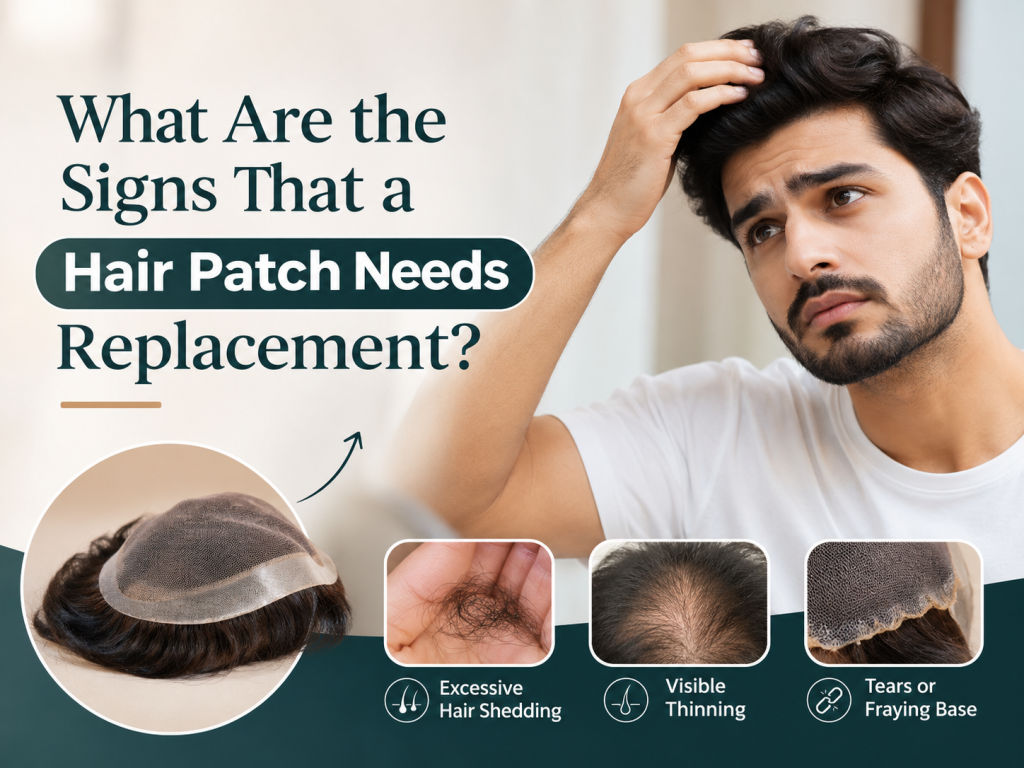
Have you been noticing more loose strands after brushing, washing, or styling your hair patch? Excessive shedding can indicate that the hair knots or patch attachment points are wearing down.
Here, a few loose hairs do not necessarily mean your hair system is damaged. But it’s better to get the hair patch checked by your hair specialist if and when shedding increases. They might be able to find a solution when repairs are possible. Allowing hair strands to fall continuously, on the contrary, can lead the patch to lose its original density and coverage. Here, replacing the hair patch in Delhi is a better option than repairing it continuously.
2. Visible Thinning or Bald Spots
Your hair patch replacement should provide the coverage you expect. But what if it’s failing to do so, leaving you with sparse areas around the crown or parting?
Problems like uneven density and visible gaps can cause areas where your scalp or the base material shows through. Minor thinning in one area may be repairable, depending on the construction. However, widespread thinning or bald spots can indicate that the hair patch is nearing the end of its usable life.
3. Dry, Brittle or Straw-Like Hair
Does your hair patch feel rough, look really dull, or start to lose its softness even after washing and conditioning? Signs like these tell us that the hair fibers of your hair system have deteriorated a lot because of:
- Repeated heat styling
- Friction, unsuitable products
- Frequent washing
All this can make fibers of hair brittle and difficult to style. You can improve the look with some care. But you may need a new hair patch in Delhi if the hair no longer improves in texture and appearance.
4. Persistent Tangling or Severe Matting
Occasional tangles can happen, especially with longer hair. However, you may need a replacement if your hair patch has:
- Frequent knots around the nape
- Hair clumps that resist detangling
- Matting that keeps returning
If these problems persist despite suitable care, the hair may have deteriorated to the point where the patch becomes difficult to manage and wear comfortably.
5. Colour Of Hair Patch Has Faded
Has your hair patch started looking lighter or taking on a reddish tint? This can happen as your patch faces regular washing, sunlight, and styling.
But a change in colour of your hair patch alone shouldn’t be a reason to replace it. A professional may be able to improve the colour if the hair still feels healthy and remains easy to style. Replacement, however, becomes worth considering when the shade cannot be corrected well, or the hair has also become rough, tangled, and difficult to manage.
6. The Base of the Patch Becomes Visible Through the Hair
A good hair patch always blends with your natural hair without drawing any attention to its base. However, this can become a problem when your natural hair starts thinning. Then, you may begin to notice the base of your hair patch a little.
It’s better to get a replacement for your hair patch in such cases. A hair specialist could then be able to offer you a new patch that is designed based on your most recent hair loss and thinning.
7. Tears, Fraying or Cracks in the Base Of Patch
The base of your hair patch is not immune to damage. It can wear down over time, leaving you with:
- A lace with tears, or the mesh with holes that cannot be repaired reliably.
- Edges that are so badly frayed that the patch no longer sits securely.
- Cracks in the base affect strength or fit for hair patches.
- Multiple tears or weak spots have left the base too fragile for regular use.
Minor damage may still be repairable. However, if the base has weakened across several areas, replacing the patch may be the more practical choice.
8. The Edges Keep Lifting After Refitting
Does your hair patch keep lifting around the front hairline or perimeter, even shortly after a refitting appointment? Repeated lifting can indicate a problem that needs more than another round of adhesive.
People sometimes think that lifting only happens only because of adhesive. However, edges of the hair patch may be lifting because of adhesive residue, unsuitable bonding products, scalp preparation, or a damaged base.
If the base remains in good condition, a refit or maintenance visit may solve the problem. But you may need to replace the hair system if the corners have deteriorated.
9. The Patch No Longer Fits Properly
Does your hair patch seem to shift, bunch up, or leave gaps where it once sat comfortably? These changes may indicate that the base has stretched or lost its original shape.
Sometimes a professional refitting can help with this. However, you may need to replace your hair patch if that doesn’t work either. The following signs specifically call for a replacement:
- Wrinkles that do not flatten
- Distorted edges
- Gaps in patches that prevent it from getting attached securely
Note that sometimes, the issue is not the base itself but your actual hair loss. Progressed loss or thinning can leave areas that the patch no longer covers naturally. In such cases, a hair specialist in Delhi can assess if adjustments work or if you’d need a new hair patch for better coverage.
10. Persistent Itching or Scalp Discomfort
Does your hair patch leave your scalp feeling itchy or irritated when it used to feel comfortable? Friction, trapped sweat, or a reaction to adhesive can often cause such discomfort. You should never ignore it and should check for persistent redness, burning, sores, or swelling.
You should consult a skin doctor for skin concerns or a hair wig specialist in Delhi to find out if there is an issue with the patch. You can decide on needed actions once the cause is clear.
Conclusion
You don’t always have to replace your hair patch just because there are some loose strands or the colour of your patch has faded. The important thing is to notice whether the problem keeps returning, affects the fit, or makes the patch look less natural despite proper care.
Are you noticing several of these signs? Consider getting your hair patch assessed by our hair specialist in Delhi. We can help determine whether a repair, refitting, or replacement is the right option for you.
Visit Radiance Hair Studio or talk to our experts today!
FAQs
Q. How often should you replace a hair patch?
Ans: Most hair patches can be used for 6–12 months. However, the lifespan of your hair patch depends on the type of base material used in its design, how many times you’re wearing it, and your maintenance routine.
Q. Can a damaged hair patch be repaired instead of replaced?
Ans: Yes, you can sometimes repair your hair patch instead of replacing it. It can be done during localised base damage or slight thinning. However, heavy hair loss and matting may require replacement.
Q. How can you make your hair patch last longer?
Ans: You can make the hair patches last longer by following mindful practices like using the right products and avoiding excessive heat styling. Also, try to detangle the patch gently and follow the recommended cleaning and maintenance routine.
Q. Can I replace only the hair patch base instead of the entire patch?
Ans: In some cases, replacing or repairing only the base may be possible. However, it depends on the extent of the damage and the condition of the hair attached to it. A hair specialist can assess whether a base replacement is suitable or whether a completely new hair patch is needed.
Q. Does frequent hair patch maintenance mean I need a replacement?
Ans: Not necessarily. Regular maintenance is part of keeping a hair patch in good condition. However, if you frequently experience hair shedding, edge lifting, tangling, or fitting issues despite proper maintenance, it may be time to consider a replacement.