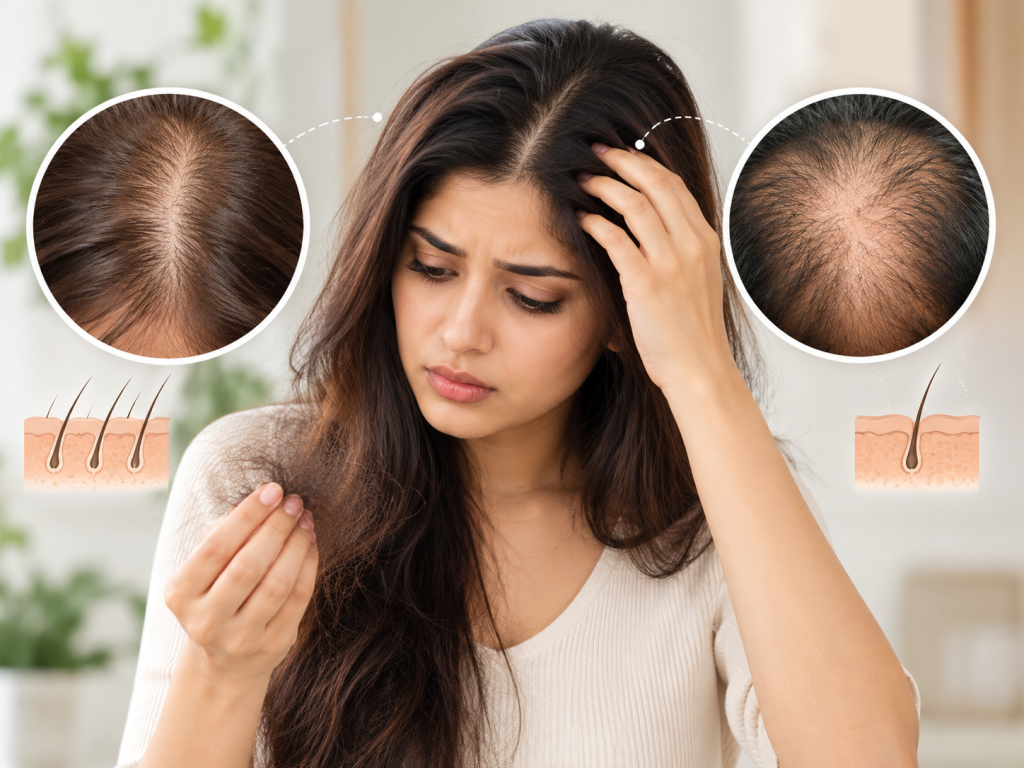
Have you noticed that your ponytail feels thinner, your part looks wider, or you are seeing more hair than usual on your pillow?
You may look at your hair and simply think, “My hair is falling.” But what you are actually noticing could be thinning, shedding, or another form of hair loss. The signs can look similar at first, yet what is happening to your hair may be quite different. That’s why it is important to understand the difference between hair loss and hair thinning.
So, how do you know what is actually happening to your hair? Let us look at the difference between hair thinning and hair loss and why knowing the difference matters.
What Is Hair Thinning?
Hair thinning means your overall hair density is gradually decreasing. Your hair may still be growing, but the strands can become finer, or fewer hairs may grow in certain areas. Since this change usually happens slowly, you may not notice it until the difference becomes more visible.
What Are the Signs of Hair Thinning?
You may notice that:
- The density of your hair is reducing
- Individual strands look finer or weaker.
- Your parting appears wider.
- Your ponytail feels noticeably thinner.
- Visible scalp through hair
What Causes Hair Thinning?
- Genetics: Some people are more likely to develop gradual thinning because of their family history.
- Ageing: Hair growth can naturally change with age, making existing thinning more noticeable.
- Hormonal changes: Changes in hormone levels can affect the hair growth cycle and reduce overall density.
The important thing is that thinning does not always mean you are suddenly losing large amounts of hair. Sometimes, the change is much more gradual, with each strand becoming finer and the overall density slowly decreasing.
What Is Hair Loss?
Have you suddenly started finding much more hair on your pillow, in your brush, or around the shower drain? Or have you noticed a receding hairline, a bald patch, or an area where the hair seems to have stopped growing?
Hair loss is a broader term for these changes. It can involve excessive shedding, reduced hair growth, or hair disappearing from specific areas of the scalp. Unlike gradual thinning, some types of hair loss can become noticeable quite quickly.
What Are the Signs of Hair Loss?
You may notice:
- Quite a sudden increase in hair shedding.
- A receding hairline that you can notice when you part your hair
- Thinning of hair around the crown.
- Clearly defined bald patches.
- A noticeable reduction in hair coverage.
- Hair loss that starts to get progressively worse with time.
What Causes Hair Loss?
- Genetics: Some types of hair loss are linked to inherited changes in how your hair follicles respond to hormones.
- Stress or illness: Physical or emotional stress, illness, surgery, or other major changes can trigger increased shedding.
- Nutritional deficiencies: Low levels of certain nutrients can affect normal hair growth.
- Hormonal changes: Changes in hormone levels can affect the hair growth cycle.
- Medical conditions: Autoimmune conditions and some scalp disorders can cause noticeable hair loss.
- Medications: Certain medicines can cause increased shedding as a side effect.
Excessive shedding after an illness can mean something very different from a bald patch or a gradually receding hairline. Looking at how the change started and how it is progressing can provide important clues about what may be happening.
Hair Thinning vs Hair Loss: What Is the Difference?
With hair thinning, your hair is usually becoming less dense, or the individual strands are becoming finer. You may still have hair growing across the scalp, but it does not feel as full as it once did.
Hair loss is different, as it can mean increased shedding, hair disappearing from certain areas, a receding hairline, or clearly defined bald patches.
| What you notice | Hair Thinning | Hair Loss |
| Main change | Hair becomes finer or less dense | Hair is shed, stops growing or disappears from an area |
| Development | Often gradual | Can be sudden or gradual |
| Common signs | Wider part, thinner ponytail, visible scalp | Excessive shedding, bald patches, receding hairline |
| Hair density | Gradually decreases | Can decrease noticeably in specific or wider areas |
| Possible causes | Genetics, ageing, hormonal changes | Genetics, stress, illness, nutritional or medical conditions |
You can sometimes even experience both thinning of hair and loss together. For example, an ongoing pattern of hair loss can gradually make individual hairs finer and reduce overall density. Similarly, heavy shedding can temporarily make your hair look much thinner.
So, looking at the pattern and progression gives you more information than simply counting the hairs you see in your brush.
Why Does Knowing the Difference Between Hair Loss And Hair Thinning Matter?
It is easy to reach for a hair oil, supplement, or hair-growth product as soon as you notice a change in your hair. The problem here is that the same approach may not make sense for every type of hair change. So, you may simply end up wasting your time and money instead of resolving the problem.
Knowing whether you are experiencing gradual thinning, excessive shedding, a receding hairline or patchy hair loss can help point towards the underlying cause. It also helps you recognise when the change needs professional attention.
If you are unsure what is happening to your hair, a professional assessment can help identify the pattern and possible cause. Once you understand the problem, you can focus on the right way to manage it instead of trying solutions at random.
Conclusion
Still wondering what is happening to your hair? Both losing hair and noticing thinning of hair can many times look the same. It is especially true when the change happens gradually. But the good news is that you do not have to keep guessing or try different hair products hoping something works. Understanding whether you are dealing with reduced density, excessive shedding, a receding hairline, or another form of hair loss gives you a much clearer starting point.
If you are still unsure, Radiance Hair Studio is here to help. Our hair specialists in Delhi are here to listen to your concerns, assess your hair, and help you understand what may be causing the change.
Visit Radiance Hair Studio today for consultations.
FAQs
Q. Is hair thinning the same as hair loss?
Ans: No, hair thinning usually refers to reduced hair density or finer strands. Hair loss is a broader term that can include excessive shedding, bald patches, receding hairlines, or reduced hair growth.
Q. How can I tell if my hair is thinning or falling out?
Ans: Gradual changes such as a wider part or thinner ponytail may suggest thinning. Noticeably increased shedding, bald patches, or a receding hairline may indicate hair loss.
Q. Can hair thinning lead to hair loss?
Ans: Yes, you can experience hair thinning while losing your hair. It is more common to experience it when hair follicles begin to produce finer hairs, reducing density over time. Identifying the cause early can help you understand what is happening and what options may be appropriate.